
Perinatal Psychosis (Pregnancy, Post-Loss, and Postpartum)
Postpartum Psychosis (PPP), also known as Perinatal Psychosis, is a serious PMH disorder that usually has an onset in the first 2-weeks (but up to a year). Postpartum Psychosis occurs in approximately 1 to 2 out of every 1,000 deliveries. Review the information below to learn more about PPP.
An active case of Postpartum Psychosis is considered an emergency, and you should reach out to one of the numbers listed below. It is important to stay with the perinatal individual and the child to ensure everyone’s safety.
Postpartum Psychosis is treatable, and help is available. You do not need a diagnosis to reach out for help.
In an Emergency/If you suspect Postpartum Psychosis
- National Maternal Mental Health Hotline1-833-852-6262 (1-833-TLC-Mama)
- Crisis Text Line Text HOME to 741741 from anywhere in the USA
- National Suicide Prevention Lifeline Call 988
Symptoms
Symptoms of Postpartum Psychosis can include:
- Delusions or strange beliefs
- Hallucinations (seeing or hearing things that aren’t there)
- Feeling very agitated
- Hyperactivity or having more energy than usual
- Severe depression or lack of emotion
- Decreased need for or inability to sleep
- Paranoia and suspiciousness
- Rapid mood swings
- Difficulty communicating at times
Immediate treatment for a person going through psychosis is imperative. Individuals experiencing Postpartum Psychosis are at higher risk of harming themselves or others (including their infant); however, it should be noted that the vast majority do not. This is because the individual experiencing psychosis is experiencing a break from reality. In their psychotic state, the delusions and beliefs make sense to them; delusions feel very real and are often religious. Immediate treatment for someone going through psychosis is imperative.
It is also important to know that many survivors of Postpartum Psychosis never experienced delusions containing violent commands. Delusions take many forms, and not all of them are destructive. The majority of individuals who experience Postpartum Psychosis do not harm themselves or anyone else. However, there is always the risk of danger because psychosis includes delusional thinking and irrational judgment, and this is why this illness must be quickly assessed, treated, and carefully monitored by a trained healthcare or perinatal mental health professional.
Postpartum Psychosis is temporary and treatable with professional help, but it is an emergency, and it is essential that you receive immediate help. If you feel you or someone you know may be suffering from this illness, know that it is not your fault and you are not to blame. It is important to stay with the perinatal individual and the child to ensure everyone’s safety. Call your doctor or an emergency crisis hotline right away so that you can get the help you need.
Risk Factors
The most significant risk factor for Postpartum Psychosis is a personal or family history of bipolar disorder, or a previous psychotic episode. It may also include prolonged lack of sleep (for instance, going days without any sleep).
Treatment Options
The majority of individuals who experience Postpartum Psychosis do not harm themselves or anyone else. However, there is always the risk of danger because psychosis includes delusional thinking and irrational judgment. It is important to stay with the perinatal individual and the child to ensure everyone’s safety. Call your doctor or an emergency crisis hotline right away so that you can get the help you need.
- Call or text the National Maternal Mental Health Hotline at 833-852–6262. Hotline Counselors are available to discuss and explore next steps for you and your loved one. Available 24/7, in the United States only.
- Intensive Treatment Facilities are available and are listed here.
After inpatient psychiatric treatment:
After emergency treatment, those individuals who have experienced Postpartum Psychosis should be followed by a doctor and therapist to continue treatment, including medication and ongoing therapy. PSI hosts peer support groups for Postpartum Psychosis survivors and those affected. Additional resources are available here.
PSI Programs & Services
Call or Text our HelpLine
1-800-944-4773 (4PPD) #1 En Español or #2 English
Text in English: 800-944-4773
Text en Español: 971-203-7773
The HelpLine will provide you with support and resources. You will be asked to leave a confidential message and a trained and caring volunteer will return your call or text.

Support Groups
PSI has over 50 specialized support groups to meet your needs.

Specialized Support Coordinators
PSI has a small team of Postpartum Psychosis survivors who are available to provide additional assistance to individuals and their families who are not in an emergency situation, but seeking support and information related to Perinatal Psychosis.
Explore Related Articles
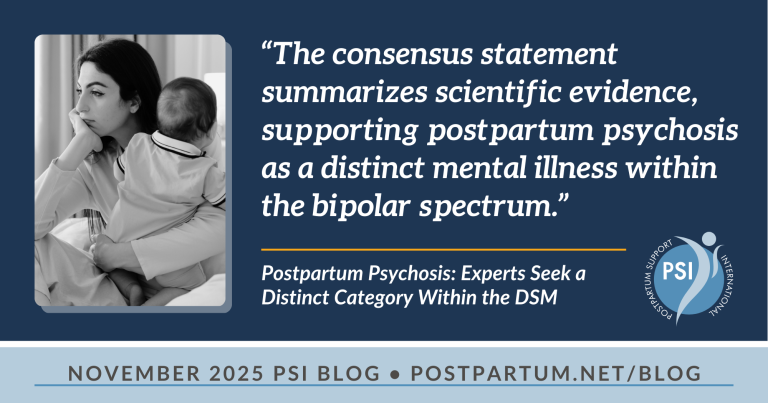
Postpartum Psychosis: Experts Seek a Distinct Category Within the DSM
We Deserve Better: The Inpatient Experience of New Mothers with Postpartum Psychosis

Cindy’s Story: Postpartum Psychosis is Not Always Obvious

Helpful Resources & Links
Postpartum Psychosis Discussion Tool
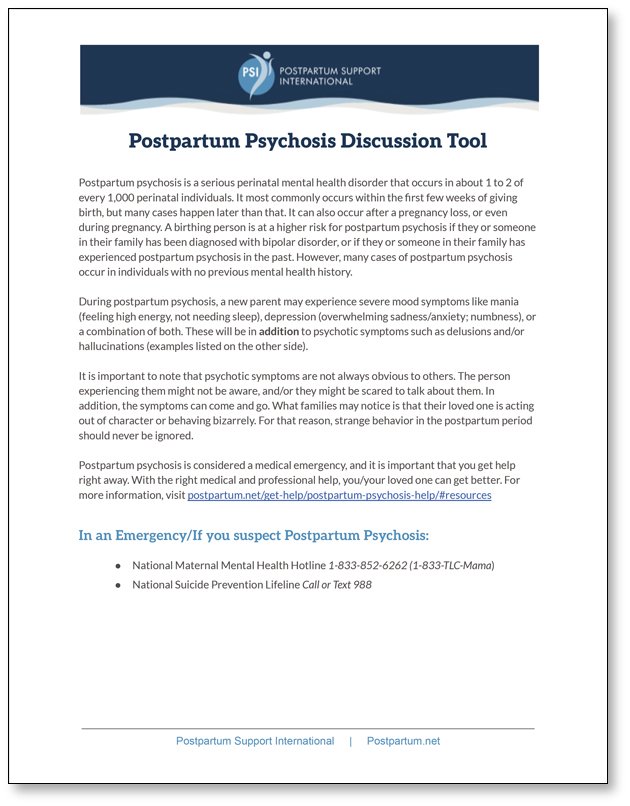
The Postpartum Psychosis Discussion Tool was developed by the PPP Taskforce. This tool is available in English and Spanish.
Download the Discussion Tool Here
Learn More
- PSI Zoom Webinar: Slaying the Monstrous Misconceptions About Postpartum Psychosis: A Roundtable Discussion
- Postpartum Psychosis MCPAP Webinar
- Postpartum Psychosis: 4 High Yield Clinical Cases
- Massachusetts General Hospital (MGH)* Free consultations to medical providers caring for patients with postpartum psychosis.
- MGH Postpartum Psychosis Project* A national research project on postpartum psychosis.
- Action on Postpartum Psychosis A U.K. network composed of women who have experienced psychosis or bipolar disorder in relation to childbirth. This site includes many helpful resources.
Read Stories
Books (in order of most recent release date)
- Alvi, Aaisha. A Mom Like That: A Memoir of Postpartum Psychosis. Dundurn Press, September 24, 2024.
- Beeston, Ariane. Because I’m Not Myself, You See: A memoir of motherhood, madness, & coming back from the brink. Black Ink, 2024.
- Ekhoff, Jessica. Super Sad Unicorn: A Memoir of Mania. New Degree Press, 2023.
- Wight, Jen. Rattled: Overcoming Postpartum Psychosis. Trigger Publishing, 2022.
- Dockrill, Laura. What Have I Done? Motherhood, Mental Illness, & Me. Vintage, 2021.
- Townsend, Sarah C.* Setting the Wire: A Memoir of Postpartum Psychosis. Chicago: The Lettered Streets Press, 2019.
- Burling, Angela D.* “Moving Out of Darkness.” In Motherhood, Mental Illness and Recovery: Stories of Hope, edited by Nikole Benders-Hadi and Mary E. Barber, 127-133. New York: Springer International Publishing, 2014.
Personal Essays and Blogs (in order of most recent release date):
- Dr. Rowena Winkler* Letters from My Postpartum Psychosis.
- Meghan Cliffel* and Susan Hatters Friedman. Tragic or Treated: Why We Cannot Miss Postpartum Psychosis. Psychiatric Times, March 7, 2025.
- Tomasi, Patricia. My Psychotic Break, Toronto Life, March 26, 2024 (includes interview with Nancy DiNuzzo*)
- Alvi, Aaisha. A Voice In My Head Told Me My Daughter Needed to Die. Multiple Doctors Sent Me Home Anyway, HuffPost, May 23, 2023.
- Abramson, Lisa. “Giving Birth Landed Me in the Psych Ward,” The New York Times, September 2019.
- “I Didn’t Know Motherhood Could Have a Dark Side Until I Saw Demons Trying to Kill My Baby,” Olivia Siegl’s story on PSI Blog,* June 2019.
Learn from Survivors
Podcasts and Interviews (in order of most recent release date):
- Perinatal OCD & Psychosis: Breaking Down the Stereotypes with Insights from Lived Experience, Featuring: Allison Livingston, Jess Pierson, and Julia Alzoubaidi — 2025
- Podcast: Mom Breaks: Science and Stories of Postpartum Psychosis
- A Mom Like That: A Memoir of Postpartum Psychosis with Aaisha Alvi
Mom and Mind Podcast, Ep 394 - Cleveland mother and a psychiatrist discuss postpartum psychosis, maternal mental health (Meghan Cliffel*)
- Kriti Lodha*–I AM ONE in 1,000 Turning Pain into Purpose after Postpartum Psychosis
I AM ONE Podcast, September 10, 2024 - Postpartum Psychosis: A Couple’s Experience with Dr. Rowena and Derek Winkler*, Mom and Mind Podcast, Ep 324 March 11, 2024
- Bodies: The Fourth Trimester (Jess Pierson*) May 31, 2023
- JESSICA EKHOFF: I AM ONE Recovered Super Sad Unicorn (PPP, Mania, Bipolar I) April 18, 2023
- JIGYNA PATEL: I AM ONE Undiagnosed Postpartum Psychosis Survivor (PPA, PPD, Psychosis) March 21, 2023
- Motherhood and Mental Illness KQED, Mina Kim interview with Angela Burling,* Diana Barnes,* April Dembosky and Michelle Oberman, February 2020.
- My Postpartum Psychosis Story with Kristina Dulaney*, GotchaMama Podcast, May 2019.
- She Wanted To Be The Perfect Mom, Then Landed In A Psychiatric Unit NPR, April Dembosky article and broadcast interview of Lisa Abramson, January 2019.
- Postpartum Psychosis, A Mother’s Story (Kristina Dulaney*). Mom and Mind Podcast, August 2017.
- This Is My Brave “Naked” (Heather Coleman*) 2014
Connect with Survivors
- Postpartum Psychosis Activism and Advocacy* By-admission. FB page for advocates/activists to share information and coordinate activities. Teresa Twomey*, lead Admin.
- Postpartum Psychosis Forum* By-admission. FB peer-support page for postpartum psychosis survivors/friends/families. Teresa Twomey,* founder and lead Admin.
- Aaisha Alvi Writes @aaishaalviwrites
Tik-Tok
- @2meteresa
- Be You T Fully You
Get Involved
- MGH Postpartum Psychosis Project* A new national research project on postpartum psychosis.
- Postpartum Psychosis Taskforce A PSI Taskforce that focuses on Postpartum Psychosis advocacy
Resources with * denote a member (current or former) of PSI’s Postpartum Psychosis Taskforce.