When Honesty Feels Too Risky: Why New Parents Hide Mental Health Struggles
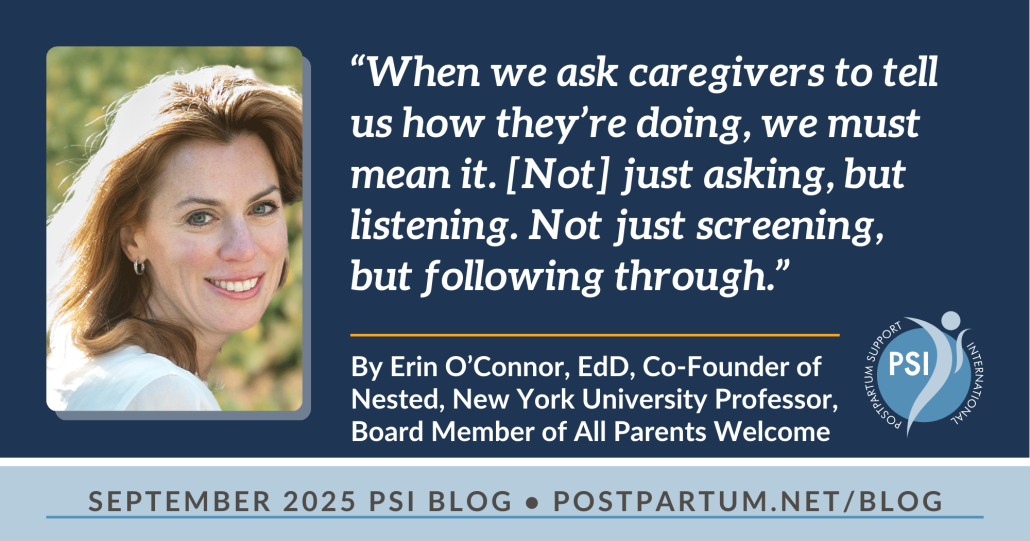
By Erin O’Connor, EdD, Co-Founder of Nested, New York University Professor, Board Member of All Parents Welcome
Many parents fear that disclosing postpartum struggles could cost them their baby. It’s time to fix the systems that make silence feel safer than support.
When Speaking Up Feels Too Dangerous
Imagine recognizing you’re not okay after having a baby. You’re overwhelmed, anxious, maybe even scared of what you might do or feel. You know you need help, but instead of saying so, you smile politely, fill out the perinatal mood and anxiety disorder (PMAD) screening with safe answers, and push through alone. Why?
Because for many new parents, honesty feels too risky.
In our new national study of over 1,000 caregivers conducted by Nested in partnership with New York University, only 36% of respondents who were screened for perinatal mood and anxiety disorders (PMADs) reported answering honestly. The rest held back out of fear that admitting to intrusive thoughts, rage, or despair might brand them unfit and cost them custody of their child.
This silent, invisible tension haunts the perinatal mental health landscape. And it’s costing families the care they desperately need.
The Fear of Losing It All
Caregivers who participated in our study spoke about this fear openly and powerfully. Their words tell the story better than statistics ever could:
“Fear that my child would be taken away from me if I were honest about how crazy I felt.”
“Fear of having my baby taken away due to my perceived incompetence or ‘mental instability.’”
“I feared I’d be judged. I feared I’d be put into a hospital against my will or have my baby taken from me.”
These are not isolated reactions. They reflect a systemic fear that any admission of postpartum distress, no matter how treatable, will be interpreted as a sign of danger.
One participant shared:
“No one ever prepared me for this. I felt so alone and scared for me and my baby, but also scared to seek help out of fear of my baby being taken away.”
This fear doesn’t just delay treatment. It actively pushes caregivers further into isolation and shame.
The Problem with How We Screen
Much of this fear stems from how PMAD screenings are currently conducted. Often reduced to a checkbox form (the Edinburgh Postnatal Depression Scale, for example), screenings can feel more like a legal liability form than a meaningful opportunity to offer care.
“The Edinburgh test feels incredibly shallow… I’d memorized which questions, and what score I needed to achieve to not raise eyebrows. It also lacks nuance, and never once did a doctor dive deeper into any of the answers. At best a nurse practitioner would glance at the sheet and sweep it up into her clipboard.”
“I was so anxious I was afraid if I was honest, they’d think I wasn’t a good mom, so I just checked all 4s with one or two 3s so it didn’t seem fake.”
Caregivers internalize the message: Don’t raise red flags. Just survive the appointment.
If the system signals that truth-telling might lead to surveillance or separation, it should come as no surprise that caregivers hide the truth.
Why Providers Often Feel Unprepared
Healthcare providers are critical allies in identifying and supporting caregivers with PMADs, but many aren’t equipped to do so.
In a 2020 study by Barkin et al., both pediatricians and OB/GYNs reported significant barriers in addressing perinatal mental health. Pediatricians often don’t consider the mother “their” patient and lack access to her medical records. OB/GYNs report insufficient training in PMAD treatment, especially around medication.
“The only drug I’m comfortable prescribing is Zoloft,” one OB/GYN admitted. “I wasn’t trained for this.”
“Would you ask a psychiatrist to deliver a baby?” asked another.
And even when a caregiver screens positive, providers don’t always know what to do next:
“If my patient screens positive, what do I do with them?”
When care teams aren’t trained or supported, the screening becomes a dead end instead of a bridge to care.
Where We Go from Here
To create a system where caregivers can be honest and get help, we need a full reset on how we approach perinatal mental health. Here’s what that looks like:
1. Screening with Safety and Transparency
Caregivers need to know their rights. Screening tools should include plain-language disclosures about confidentiality, mandated reporting, and available support options. Clarity reduces fear.
2. Trauma-Informed Provider Training
Medical professionals should be trained to recognize PMADs without jumping to crisis response. Trauma-informed approaches build trust and reduce the risk of retraumatization.
3. Investing in Clinical Capacity
We need to fund more perinatal mental health specialists and integrate mental health care into OB and pediatric settings. As the American College of Obstetricians and Gynecologists recommends, the “fourth trimester” deserves focused support.
We Cannot Afford to Make Parents Choose Between Help and Custody
When we ask caregivers to tell us how they’re doing, we must mean it.
That means not just asking, but listening. Not just screening, but following through. And not punishing parents for being human.
Caregivers shouldn’t have to choose between telling the truth and protecting their child. They deserve care that honors their vulnerability.
Reference:
Barkin, J. L., Osborne, L. M., Buoli, M., Bridges, C. C., Callands, T. A., & Ezeamama, A. E. (2020). Training frontline providers in the detection and management of perinatal mood and anxiety disorders. Journal of Women’s Health, 29(7), 889.
About the Author

Erin O’Connor, EdD
Erin O’Connor, EdD, is a Full Professor and Director of Early Childhood Education at New York University, where she studies how relationships with caregivers and teachers impact child development. She is also the co-founder of Nested, a nonprofit research institute focused on caregiver mental health and family well-being. Erin holds advanced degrees from Harvard, Columbia, and Fordham, and her work has been featured in leading psychology and education journals. She co-hosts the Parenting Understood podcast and is passionate about translating research into action for families.
Explore More PSI Resources:
Connect with Knowledgeable Providers Using the PSI Directory
Professional Perinatal Mental Health Training
Perinatal Mental Health Signs, Symptoms & Treatment
Connect by PSI
Download our free app “Connect by PSI” in your app store to access PSI support, resources, and information in the palm of your hand.